


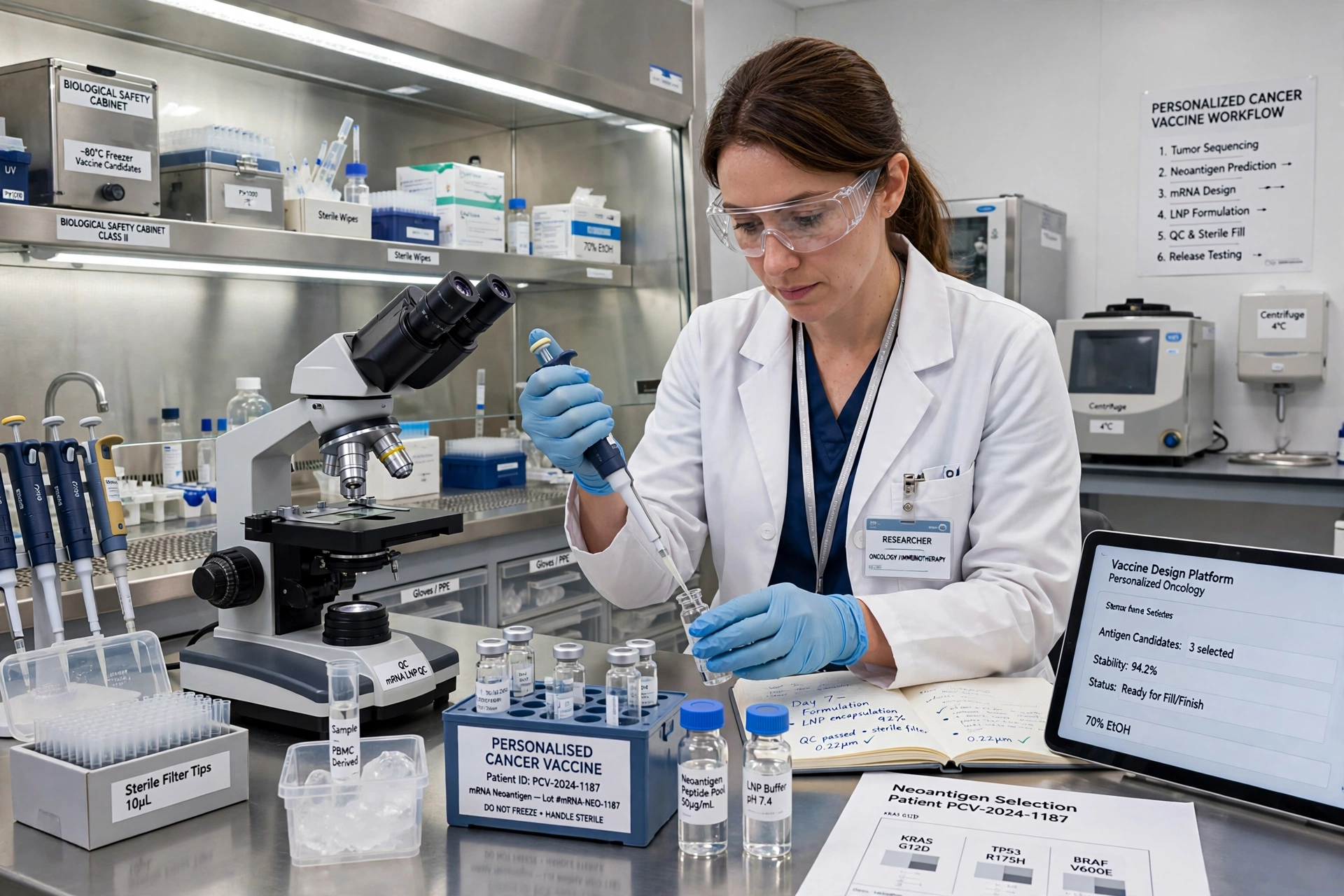
Some medicines are made in vast vats for millions of strangers. This one was made one patient at a time, in small batches matched to a single person’s cancer. NeoVax, a personalised neoantigen vaccine built from each patient’s own tumour mutations, has been tested with the immunotherapy drug nivolumab in a phase 1 trial in platinum-sensitive recurrent ovarian cancer, and the results have been published in Nature Medicine. In keeping with the scale of the study, the findings are modest and specific: the vaccines could be made and given, safety was acceptable, and the immune system responded. A small trial, carefully reported, deserves a careful reading.
Made to Measure, Literally
The making is the story. A tumour’s mutations are its misprints, and some of those misprints create neoantigens, fragments of protein that appear on cancer cells and nowhere else in the body. For every participant, researchers read the tumour, chose its most distinctive neoantigens, and manufactured a vaccine from that recipe alone. Change the patient and the recipe changes entirely. It is bespoke production in the fullest sense, closer to a tailor’s single commission than to a factory run, and until now a fair question was whether such a process could work at all outside theory.
Nivolumab, the partner drug, is a PD-1 checkpoint inhibitor, a class of treatment that loosens restraints on immune cells. The pairing is thoughtful: NeoVax shows the immune system what to hunt, and nivolumab tries to keep the hunters active. We often celebrate this kind of craft and intentionality in far lighter contexts, such as our recent feature on makers and the value of things produced in limited runs, and there is a recognisable kinship here: limited runs, close attention, and quality judged piece by piece.
What the Small Trial Found
The study enrolled patients whose ovarian cancer had returned yet remained platinum-sensitive, having responded to platinum chemotherapy before. As a phase 1 trial, its job was to test feasibility and safety first. Could a personalised vaccine be produced for each woman in the trial and delivered on schedule together with nivolumab? It could. Were side effects within acceptable limits for patients in this situation? They were. Did vaccination stir the intended immune response, with T cells reacting to the chosen neoantigens? Measurements said yes.
The full account appears in Nature Medicine, a venue whose peer review carries weight, and the authors’ own language is measured throughout. That restraint is worth noticing. In a media environment that rewards grand claims, a research team describing its work as a feasibility study is telling you exactly how far the evidence reaches.
What It Did Not Find
It did not find a cure, and it was never built to. A small phase 1 study cannot show that a treatment helps patients live longer or better, and this one makes no such claim. Recurrent ovarian cancer remains a grave illness with limited options, which is exactly why early, honest results matter and why inflating them would be a disservice to the very patients the research hopes to serve. Reference material from Dana-Farber Cancer Institute, a leading centre in vaccine research of this kind, consistently presents personalised vaccines as investigational, available through trials rather than routine care.
There are practical questions too. Making one vaccine per patient is slow and costly, and whether the process can be refined, the way a workshop refines a technique over successive batches, will shape whether the idea can ever reach many patients.
A Small Batch Worth Watching
Judged on its own terms, the trial succeeded at the tasks it set itself: a fully personalised vaccine, produced patient by patient, was delivered safely with nivolumab and provoked the targeted immune responses. Larger studies must now decide whether those responses translate into real benefit. Until they do, the fairest summary honours the scale of the work. This was a small batch of evidence, meticulously made, and like many small batches, its value lies in proving the recipe can be followed at all. Everything else remains to be brewed, tested and proven in time.
